
Birds can quickly turn the sheltered space beneath a solar array into a convenient nesting area. Once they settle in, the problem can extend beyond the occasional bird on the roof. Twigs, feathers, nesting material and droppings can build up around the panels, while repeated bird activity can create extra cleaning and maintenance around the solar system, roof and gutters.
There are several ways to approach solar panel bird proofing in Melbourne, including perimeter mesh, bird spikes, bird wire, netting and visual or sound deterrents. However, these options do not all solve the same problem. Some physically prevent birds from reaching the space beneath solar panels, while others are designed mainly to discourage birds from landing or roosting on particular surfaces.
Understanding that difference makes it much easier to choose an appropriate solution. If birds are already nesting underneath an array, we need to deal with access to that space. If they are simply perching on an exposed roof edge, a deterrent may be sufficient. Below, we compare the main bird-proofing options and explain where each approach makes the most sense.
Why Solar Panel Bird Proofing Can Prevent Bigger Problems
Solar panels create exactly the type of environment that some birds look for when choosing somewhere to shelter. The gap between the panels and the roof provides shade and protection from weather, while the surrounding panel structure can make the space relatively difficult for larger predators to reach.
Once birds begin returning to the same location, the area beneath the array can gradually fill with nesting materials and other debris.
Bird activity can also create a wider maintenance problem. Droppings may collect on the panel glass, roof and gutters, causing your solar output to drop, while loose feathers, twigs and nesting material can spread around the array. If we only clean the visible contamination without addressing birds repeatedly accessing the space underneath the panels, the same issue can return.
Effective solar panel bird proofing for Melbourne homes and businesses is therefore about identifying the behaviour we are trying to stop. The solution for birds nesting beneath panels can be very different from the solution for birds simply resting on a roofline.
Nesting Material Can Accumulate Under the Solar Array
One of the difficulties with under-panel nesting is that much of the problem remains hidden from ground level. We may see birds repeatedly entering and leaving the array, but the amount of nesting material underneath the panels may not be obvious until the area is inspected more closely.
Twigs, feathers, leaves and other material can accumulate around the panel perimeter and nearby roof surfaces. This can make cleaning and inspection more difficult and create another area of the solar system that requires ongoing attention.
Bird Droppings Can Lead to Repeated Cleaning
Bird droppings are quite different from light surface dust because they can adhere firmly to the solar panel glass and remain after normal rainfall. When birds regularly roost or nest around a solar system, droppings can repeatedly appear across the panels and surrounding roof.
Professional solar panel cleaning can remove existing contamination, but where birds are living underneath the array, we also want to consider why the contamination keeps returning. Bird proofing can address that underlying source rather than relying only on repeated cleaning.
Bird Activity Can Make Solar Maintenance More Difficult
A solar system should remain reasonably accessible for inspection and maintenance. When birds have been nesting beneath the panels for an extended period, built-up debris can make that work more complicated.
By addressing regular nesting activity, we can help keep the area around the array cleaner and easier to assess as part of ongoing solar maintenance.

What Should We Look for in a Solar Panel Bird Proofing System?
There is no single bird-control product that is ideal for every part of a property. Before we compare mesh, spikes and other options, it helps to establish what an effective solution actually needs to achieve.
The first question is whether birds are getting underneath the solar panels. If they are, we generally need a physical exclusion method that closes the entry point. If birds are instead landing on an exposed ledge or roof edge, we may be dealing with a roosting problem rather than a nesting problem.
We also need to consider the layout of the solar system, roof access, durability, installation method and how easily the solution can be maintained over time. A bird-proofing system should suit the actual array rather than being treated as a one-size-fits-all accessory.
Got more questions? Talk to our team at Cleantek, about solar panel bird proofing – 1300 13 25 14
Does the System Physically Stop Access Beneath the Panels?
For established under-panel nesting, this is the most important question. A product may make a roof less appealing to birds without actually preventing them from accessing the protected cavity beneath the solar array.
Physical exclusion works differently. Rather than relying on birds being frightened or discouraged, the goal is to remove the entry route altogether.
Is the Problem Nesting, Roosting or Both?
Bird behaviour matters. We sometimes see birds nesting under panels while also using ridgelines, gutters or nearby ledges as roosting points. In those cases, there may be more than one behaviour occurring on the same property.
Understanding where the birds are actually spending their time allows us to choose an approach that addresses the problem rather than simply installing a product because it is commonly marketed as bird proofing.
Is the Installation Suitable for the Solar Array?
Solar panels, frames and mounting systems should not be modified casually. The attachment method used for any bird-proofing product needs to suit the installation, and manufacturer requirements should be considered where relevant.
Before work begins, we want to understand the particular panel layout and determine how the exclusion barrier can be securely fitted around corners, cables and changes in the array without unnecessary modification to the system.
Solar Panel Bird Mesh: How Physical Exclusion Works
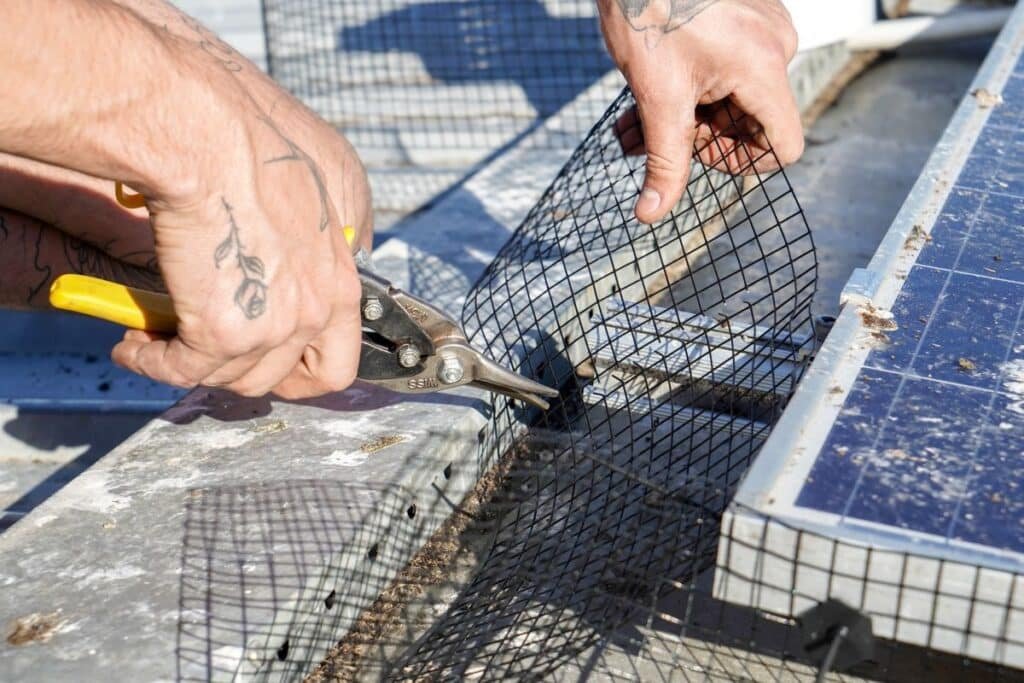
Solar panel bird mesh is designed to close the gap around the outside of a solar array. Instead of attempting to scare any birds away, the mesh forms a physical perimeter that helps stop pigeons and similarly sized birds from entering the sheltered space underneath.
This is an important distinction. If pigeons are already nesting beneath the panels, removing them temporarily won’t stop them from returning once you have cleared the area. Closing the available entry points tackles the access problem directly.
For many solar arrays affected by established nesting, we use purpose-built bird-proofing mesh because it can be installed around the perimeter while accommodating the shape of the panel system.
Why Bird Mesh Works Well for Under-Panel Nesting
The biggest advantage of bird mesh is that it provides passive protection. Once the accessible perimeter has been properly enclosed, the solution does not depend on birds continuing to respond to a sound, reflective object or visual scare device.
Mesh can also be formed around corners and irregular sections of an array, making it suitable for many residential and commercial panel configurations. Where installation conditions allow, it provides a straightforward way to separate birds from the sheltered space they have been using.
Because the goal is exclusion rather than harm, the system can continue working without needing to chase birds away each time they return to the property.
What Are the Limitations of Solar Bird Mesh?
Bird mesh is not intended to solve every bird problem on a roof. Its primary purpose is preventing access beneath the solar array. A bird may still be able to land on top of a panel, roof ridge, antenna or nearby structure.
Installation quality is something that also matters. If the corners are poorly secured or some gaps remain around part of the array, birds may exploit those openings. That is why we assess the complete perimeter rather than concentrating only on the most obvious entry point.
We also need to consider existing nesting material before closing the space. Where debris or significant contamination has accumulated around the solar array, cleaning and preparation may be an appropriate action before the mesh is fitted. If an active nest is present, we also need to consider the species involved and any applicable wildlife requirements before disturbing it.
Bird Spikes: Effective for Perching but Not Under-Panel Access
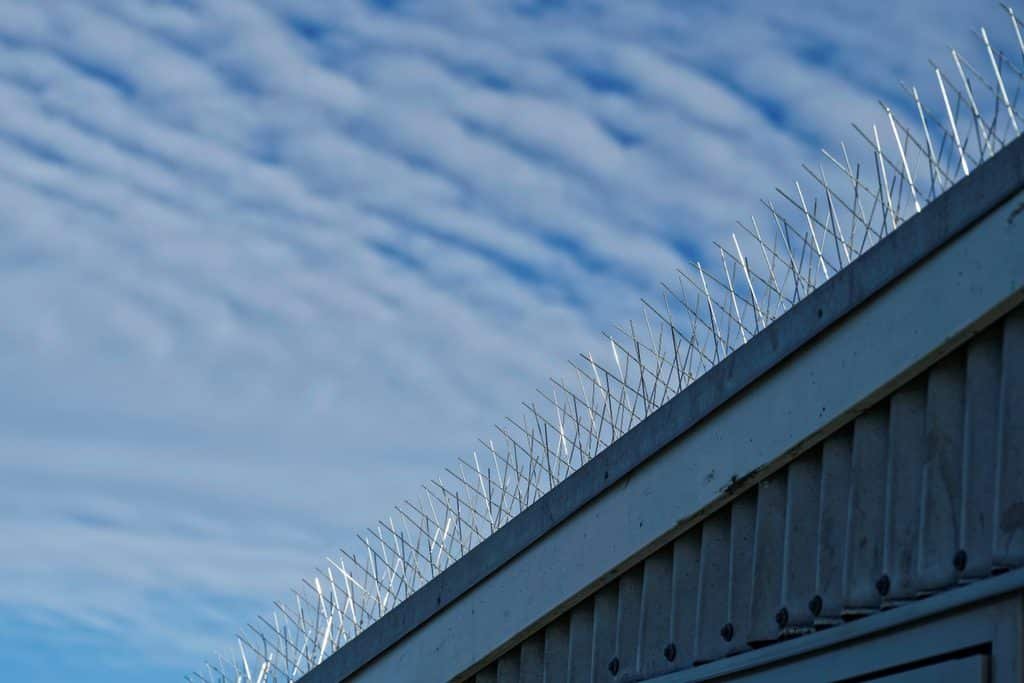
Bird spikes are one of the most recognisable bird-deterrent products. They are commonly installed on ledges, signs, parapets and other narrow surfaces where birds repeatedly land or roost.
The spikes make these particular surfaces difficult or uncomfortable for birds to use. This can make them useful where the problem is concentrated on a defined landing area.
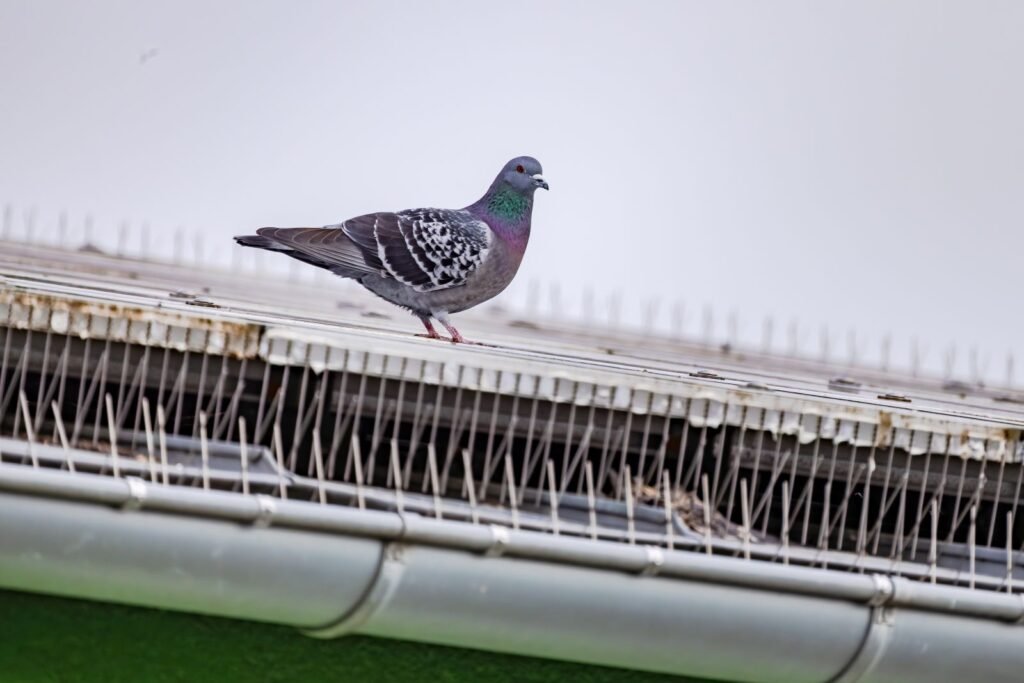
However, bird spikes work very differently from solar panel mesh. They generally do not create a continuous barrier around the gap between the panels and roof. If pigeons can still enter underneath the solar array from another point, spikes on an exposed edge may do little to prevent nesting.
When Can Bird Spikes Be Useful?
Bird spikes can make sense when we have identified a specific surface that birds repeatedly use for perching. Examples might include a roof ledge, sign, beam or other narrow structure near the solar system.
In that situation, the objective is not necessarily to stop birds entering a cavity. It is to make a known landing point less attractive.
Why Spikes May Not Stop Birds Nesting Beneath Solar Panels
If birds are disappearing underneath the panels, we need to consider the opening itself. A deterrent installed nearby does not necessarily remove access.
This is why we would not automatically treat spikes as a substitute for perimeter mesh. They solve different problems. Mesh provides exclusion around the array, while spikes are primarily a surface-level roosting deterrent.
There may be situations where both approaches have a role on the same property, but we would base that decision on observed bird behaviour rather than assuming that more products automatically provide better protection.
Bird Wire: A Targeted Option for Regular Landing Areas
Bird wire uses tensioned wires to discourage birds from settling on particular ledges or other predictable landing points. Like spikes, its primary purpose is to deter roosting rather than excluding birds from getting under the panels.
It can be a discreet option for suitable architectural surfaces, particularly where there is a clearly defined area that birds repeatedly use.
For solar panel bird proofing, however, we still need to ask whether the birds are actually accessing the cavity beneath the array. If that opening remains available, bird wire on another part of the roof does not physically prevent nesting underneath the panels.
Bird Netting: Better Suited to Some Larger Spaces
Bird netting is another physical exclusion method, but it is normally used differently from purpose-built solar mesh. Netting can be installed to protect larger areas such as open building sections, loading areas or other structures where birds need to be kept out of an entire space.
For a standard rooftop solar array, we generally want a more targeted solution. Purpose-built perimeter mesh allows us to close the relatively narrow gap around the solar panels without enclosing a much larger portion of the roof.
The terminology can sometimes be confusing because people use the words mesh and netting interchangeably. What matters is how the product is being used, what material it is made from and whether it is properly suited to the panel perimeter.
Visual and Sound Deterrents: Why Results Can Vary
Visual deterrents include reflective objects, moving devices, predator-shaped decoys and similar products intended to make birds feel uncomfortable around a particular area. Sound-based and ultrasonic devices take a similar behavioural approach by attempting to discourage birds from remaining nearby.
These methods may be useful in particular environments, but their performance can vary. Birds respond differently depending on the species, surroundings and placement of the deterrent, and some birds may become accustomed to devices that remain unchanged for long periods.
The larger issue with an existing solar nesting problem is that these products still do not physically close the entry point beneath the panels. If a bird is strongly motivated to return to an established nesting area, relying exclusively on a deterrent may leave the underlying access problem unresolved.
We therefore see visual and sound devices as fundamentally different from a perimeter exclusion system. One attempts to influence behaviour. The other physically prevents entry.
Bird Repellent Gels and Surface Treatments: What Should We Consider?
Bird repellent gels and similar surface products are another option sometimes marketed for roosting control. These products are normally applied to selected surfaces to make landing less attractive.
Before using any surface treatment around a solar installation, we need to consider where it is intended to be applied, how it performs in outdoor conditions and whether it is compatible with the surrounding materials. We would not apply an unknown coating or chemical directly to solar panels without appropriate product and manufacturer guidance.
As with spikes and wire, repellent gels also do not normally provide physical exclusion beneath the array. They may address a landing area, but that does not automatically solve an established nesting problem.
Solar Bird Mesh vs Spikes and Other Options: Which Solution Does What?
The easiest way to compare bird-proofing products is to look at the behaviour each one is designed to address.
| Bird-Proofing Option | Under-Panel Exclusion | Roosting Deterrence | Physical Barrier | Typical Application |
| Solar bird mesh | Yes | Limited | Yes | Closing access beneath solar panels |
| Bird spikes | No | Yes | No | Ledges and common landing areas |
| Bird wire | No | Yes | No | Targeted ledges and roof features |
| Bird netting | Yes, depending on installation | Can | Yes | Larger open areas or structures |
| Visual deterrents | No | Variable | No | Supplementary behavioural deterrence |
| Sound or ultrasonic deterrents | No | Variable | No | Situational behavioural deterrence |
| Repellent gels | No | Can | No | Selected landing surfaces |
The comparison makes one point particularly clear. There is a difference between stopping birds from landing somewhere and stopping them from getting somewhere. If pigeons are nesting under solar panels, we usually need to focus on closing their access rather than simply making another part of the roof less appealing.
How We Assess the Right Bird Proofing Approach
Before recommending solar panel bird proofing, we look at the actual system and the pattern of bird activity. Two properties can have similar solar arrays but very different problems depending on the roof layout, surrounding environment and where birds have established themselves.
We look for evidence of entry beneath the array, nesting material, droppings and repeated bird movement. We also consider roof height, pitch and safe access because these factors affect how the work can be carried out and how the mesh needs to be fitted.
We Check the Full Solar Panel Perimeter
Birds do not necessarily use the most visible side of an array. They may enter around a corner or another section where the space between the panel and roof is easier to access.
For that reason, we assess the perimeter as a complete system. Corners, cables and irregular panel layouts need particular attention because an exclusion barrier is only effective when the accessible entry routes are properly addressed.
We Assess Existing Nesting and Contamination
If birds have been active beneath the solar panels for some time, there may already be a significant amount of nesting material and contamination present.
Where appropriate, the area should be prepared before access is closed. Solar panel or gutter cleaning may also make sense when droppings and debris have spread beyond the underside of the array.
This can be more practical than installing bird proofing first and then trying to deal with existing contamination afterwards.
Should You Install Solar Panel Bird Proofing Yourself?
DIY bird-proofing products are readily available, but installing them on a rooftop solar system involves more than cutting mesh to size.
Roof access is one of the biggest concerns. Solar panels are frequently installed on pitched roofs, and areas around the array may be difficult to reach safely. Climbing onto a roof simply to investigate bird activity can create an unnecessary risk, particularly where appropriate fall protection and access equipment are not available.
The solar installation itself also needs to be considered. Improvised clips, drilling or unsuitable fixings can introduce avoidable problems. We want any bird-proofing method to work with the existing system rather than compromising frames, wiring or other components.
Finally, a DIY installation that leaves only a small accessible gap may not solve the problem. Birds that have already established a nesting location can be persistent, so corners and perimeter sections need to be secured properly.
What Should Professional Solar Panel Bird Proofing Include?
A professional service should start with an assessment rather than simply arriving with a roll of mesh. The solar array, roof configuration and extent of bird activity all affect the way the job should be approached.
Depending on the property and conditions, our solar bird-proofing process can include:
- inspecting the solar panel perimeter and accessible roof area
- identifying likely bird entry points and nesting activity
- removing accessible loose nesting material where safe and permitted
- preparing the perimeter before mesh installation
- installing purpose-built bird-proofing mesh
- fitting mesh securely around corners, cables and irregular sections
- inspecting the completed perimeter
- arranging solar panel or gutter cleaning where required
This approach gives us the opportunity to address both the immediate bird problem and the surrounding maintenance issues rather than treating the mesh as an isolated add-on.
How Bird Proofing Can Make Solar Maintenance Easier
Bird proofing is not a replacement for normal solar panel cleaning or maintenance, but it can help remove one recurring source of contamination.
If birds repeatedly nest beneath an array, simply cleaning droppings from the panel glass may only provide a temporary improvement. The birds can return, new nesting material can appear and contamination can begin accumulating again.
By preventing access to the sheltered area beneath the panels, we can reduce ongoing nesting activity and make it easier to keep the solar system and surrounding roof area clean. Regular solar panel cleaning for Melbourne homes or businesses can then focus on normal environmental contamination such as dust, pollen, pollution and general grime rather than repeatedly dealing with the consequences of an active nest beneath the array.
Bird proofing can also be considered alongside gutter cleaning where feathers, twigs and other debris have moved from the solar array into surrounding drainage areas.

Which Solar Panel Bird Proofing Option Is Right for Your Property?
The right option depends on what the birds are actually doing.
If pigeons or other birds are regularly entering the space beneath your solar panels, perimeter mesh is designed to address that problem directly by physically closing the opening.
If birds are mainly perching on a particular roof ledge or exposed architectural feature, spikes or bird wire may be appropriate for that specific landing area.
If an entire open section of a commercial building or structure needs to be protected, a larger netting system may be more suitable.
Visual, sound and surface deterrents can also have applications, but we would not confuse them with physical exclusion. They attempt to discourage birds from using an area rather than preventing access to it.
In some cases, a property can have more than one bird-control issue. That is why we prefer to assess the behaviour first and choose the solution second.
Professional Solar Panel Bird Proofing in Melbourne
When birds begin nesting beneath a solar array, dealing with the problem early can make ongoing maintenance much easier. At Cleantek Group, we provide solar panel bird proofing for Melbourne homes and businesses using purpose-built mesh designed to close access around the perimeter of the array.
We assess the panel layout, roof access, existing bird activity and condition around the system before recommending how the area should be protected. Where required, we can also discuss solar panel cleaning and gutter cleaning so existing droppings, nesting material and debris can be addressed as part of the wider job.
The objective is straightforward. We want to keep birds out of the space beneath the panels while keeping the solar system cleaner, more accessible and easier to maintain over the long term.
If you are seeing birds repeatedly disappear beneath your solar panels, noticing nesting material around the array or dealing with recurring droppings across your roof, contact our team to discuss solar panel bird proofing in Melbourne and request a quote.
Phone: 1300 13 25 14
Email: info@cleantekgroup.com
Frequently Asked Questions About Solar Panel Bird Proofing
Is Bird Mesh or Bird Spikes Better for Solar Panels?
It depends on the problem. If birds are nesting underneath the solar panels, mesh is designed to physically close the perimeter and prevent access to that space. Bird spikes are more appropriate for discouraging birds from landing or roosting on particular exposed surfaces. We would choose the solution based on where the birds are actually going rather than treating one product as universally better than the other.
Does Bird Mesh Damage Solar Panels?
A bird-proofing system should use an attachment method suitable for the particular solar installation. We assess the panel configuration and can discuss the proposed installation method and any relevant manufacturer considerations before work begins. We avoid making blanket assumptions about warranty requirements because these can vary between systems and manufacturers.
Do Bird Spikes Stop Pigeons Nesting Under Solar Panels?
Not necessarily. Spikes can discourage pigeons from landing on a particular ledge or surface, but they do not normally close the gap beneath a solar array. If pigeons can still reach the sheltered cavity under the panels, the nesting opportunity remains available. Perimeter mesh is designed specifically to close that access.
Should Solar Panels Be Cleaned Before Bird Mesh Is Installed?
Where significant droppings, nesting material or other debris has accumulated, we generally consider cleaning and preparation before the perimeter is closed. The condition of every system is different, so we assess what is present before deciding what preparation is appropriate.
Can Pigeons Get Back Under Solar Panels After Mesh Is Installed?
Properly fitted perimeter mesh is intended to prevent pigeons and similarly sized birds from entering the space beneath the array. Installation quality is important because unsecured corners or gaps can provide another entry route. We therefore inspect the complete perimeter and pay particular attention to irregular sections of the solar layout.
Can Bird Proofing Be Installed on Existing Solar Panels?
Yes, bird-proofing mesh can be retrofitted to many existing solar systems. Before installation, we assess the array configuration, roof access and current level of bird activity. Systems with heavy existing nesting or contamination may require additional preparation before the perimeter is enclosed.
How Long Does Solar Panel Bird Mesh Last?
There is no single lifespan that applies to every installation. Longevity depends on the quality of the mesh and fittings, installation method, roof conditions and environmental exposure. A purpose-built system that is correctly installed and periodically checked as part of normal solar maintenance is intended to provide long-term exclusion rather than a temporary deterrent.
Is Solar Panel Bird Proofing Suitable for Commercial Properties?
Yes. Bird proofing can be used on residential and commercial solar arrays throughout Melbourne. Larger commercial systems may involve more complex layouts, greater roof-access requirements and a larger perimeter, so we assess those sites individually before recommending an installation approach.